AttackMap
Local-first defensive security analysis for real codebases.
AttackMap reads a repository the way an attacker would — mapping its attack surface, tracing tainted data to dangerous sinks, scoring exploitability, and (optionally) having an LLM reason over the whole evidence pack. Everything runs on your machine; nothing is uploaded unless you explicitly enable an LLM backend.
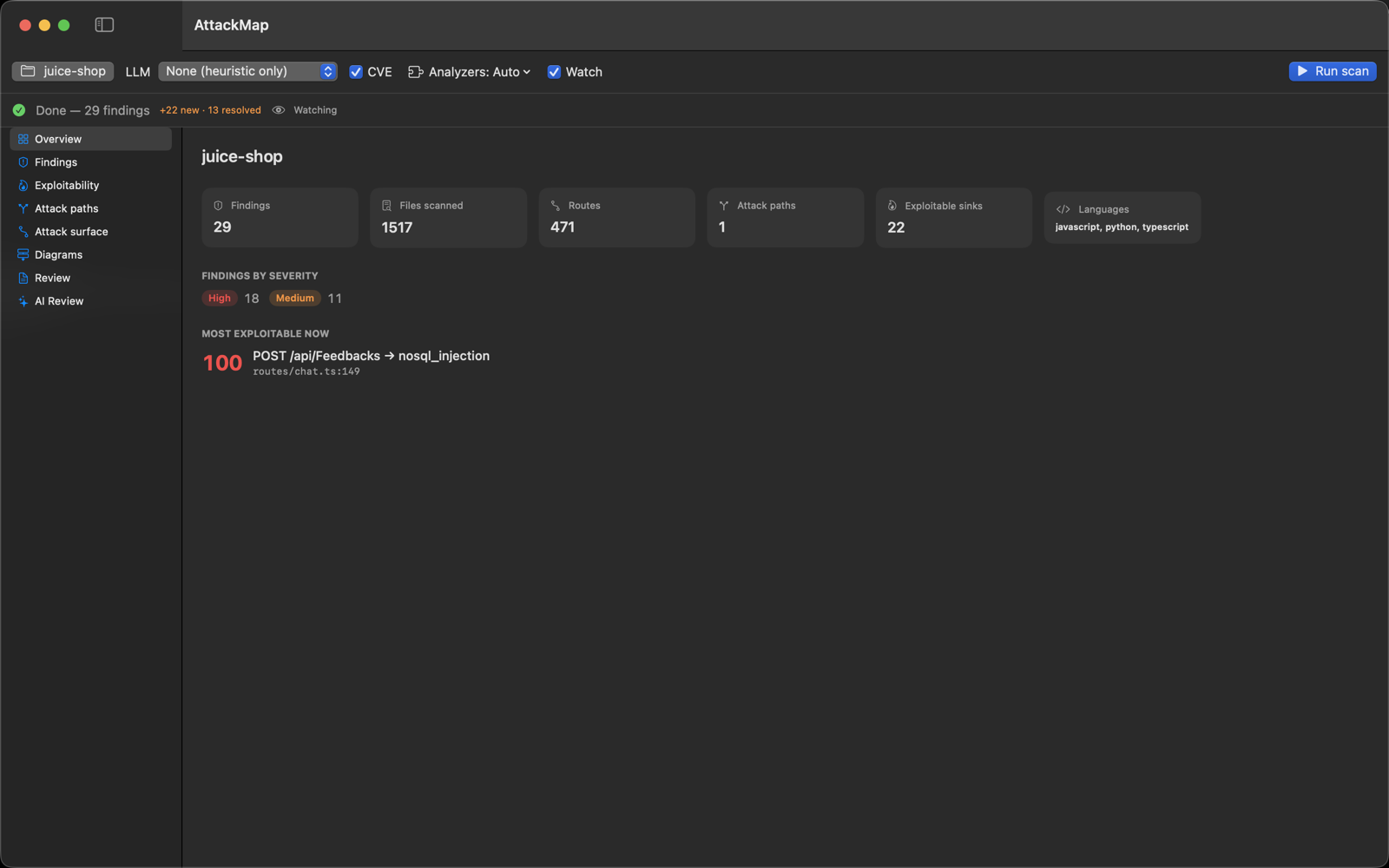
The macOS app after scanning OWASP Juice Shop — 29 findings, 22 exploitable sinks, and the single most exploitable route→sink path ranked first. See the macOS app page for the full walkthrough.
pip install "attackmap[all] @ git+https://github.com/mlaify/AttackMap.git"
attackmap analyze /path/to/repo --output reports
What it does
- Attack-surface mapping — routes, entry points, exposure, and auth signals across many languages.
- Taint analysis — import-graph data-flow from untrusted sources to injection sinks (SQLi, SSRF, SSTI, deserialization, and more), with sanitizer awareness: a chain that passes through a known escaper/validator/binder (
shlex.quote,secure_filename,is_safe_url, driver escapers, …) is downgraded instead of firing a false positive. - Anomaly & invariant mining — the odd-one-out among sibling routes, plus signature-free invariant mining: a handler that reaches a dangerous sink without the guard its peers apply.
- Exploitability scoring — fuses signals (including CVEs on the path) into a ranked, honest view of what matters.
- Dependency CVEs — cross-reference your SBOM against OSV.dev (
--cve). - AI review + verify jury — narrative defensive review and vulnerability-hypothesis hunting adjudicated against cited source, scaling into a jury (
--verify-votes/--hunt-lenses/--hunt-rounds), plus remediation and triage (--llm/--hunt --verify/--remediate/--triage). - Recall mode — verifier-gated aggressive discovery (
--recall): widens the taint walk and enumerates capability-reach, marking the extra reach speculative for the verifier to adjudicate. - Cross-repo / fleet analysis — scan multiple services at once (
attackmap analyze repoA repoB …) and surface the bugs in the seams: cross-boundary (confused-deputy) flows, trust-assumption gaps, and the sibling service that omits a control its peers enforce. - CI-friendly — SARIF, a PR summary bot, and baseline diff gating.
Status
AttackMap is beta. It's a precision-first heuristic tool — a strong lead generator and reviewer aid, not a substitute for manual review.
Where to go next
- Install — pipx, pip, or the macOS app.
- Quickstart — your first scan in two minutes.
- AI review — Claude or OpenAI/Codex, and how auth resolves.
- Analyzer SDK — write your own ecosystem analyzer.